Agentic AI: The Next Frontier Your Business Needs to Understand Before Everyone Else Does
For the past few years, the AI tools most people used shared a fundamental characteristic: they waited. You gave them input. They produced output. You decided what to do with it. The AI was reactive, not proactive. It had no ability to take actions in the world, no ability to follow through, no ability to chain steps together without you steering each one.
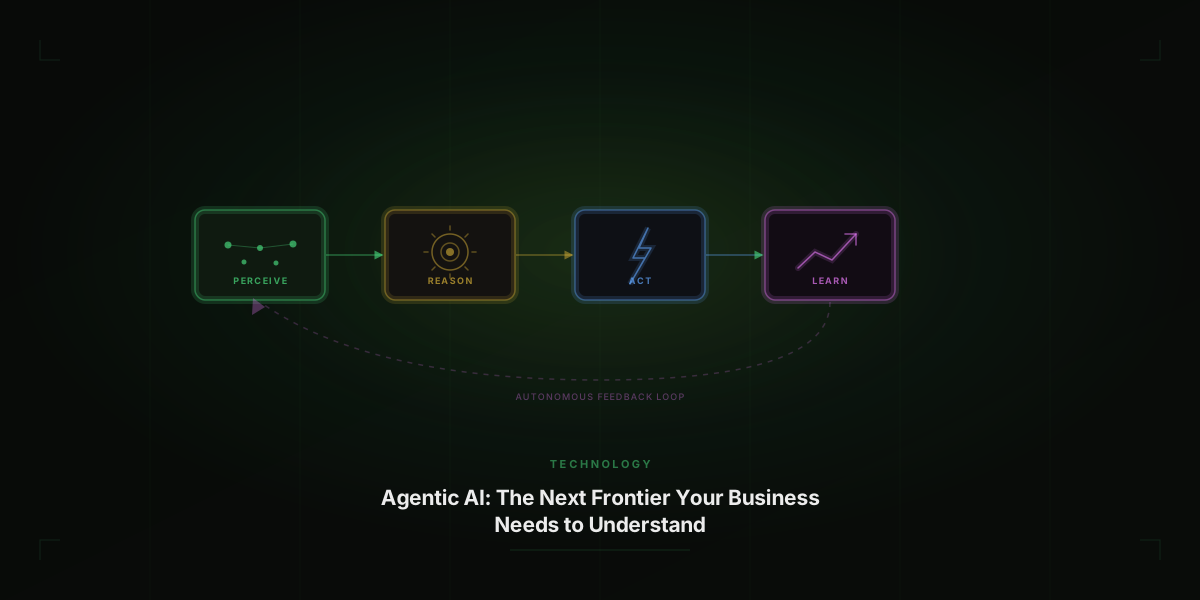
That model is being replaced — slowly in some places, rapidly in others — by something fundamentally different: agentic AI. AI that receives a goal and works autonomously toward it, taking multiple steps, making intermediate decisions, using tools, and producing results without requiring you to hold its hand through each stage.
Search trends confirm that this is moving from the labs to mainstream awareness fast. Searches for "AI agents," "autonomous AI," "AI that takes actions," "AI that can use my computer," and "agentic AI" have surged dramatically since late 2025. The people searching these terms aren't academics or researchers — they're business owners trying to understand what's coming and whether they need to pay attention.
The answer is yes. And this article will tell you exactly why, what it means for your business, and how to think about getting ready for it.
What Agentic AI Actually Is — A Plain-English Explanation
The clearest way to understand the difference between conventional AI and agentic AI is through an example.
Conventional AI workflow: You ask ChatGPT to write a cold email to a prospective customer. You paste in the customer's name and company. ChatGPT writes the email. You review it, edit it, copy it into Gmail, and send it. You then check whether the customer responded, and if not, you decide whether to follow up and when, and you write the follow-up yourself.
Agentic AI workflow: You tell the AI agent "qualify and reach out to the top ten prospects on this list." The agent searches the web to research each company, identifies the right contact at each one, finds their email address, writes a personalized email based on what it found, schedules the sends, monitors for responses, and generates a follow-up for anyone who hasn't replied after three business days. It presents you with a summary of what it did and flags any responses that need your attention.
The difference isn't incremental. It's the difference between a tool that makes individual tasks faster and a system that executes complete workflows autonomously.
Where Agentic AI Is Already Deployed in Production
This isn't hypothetical. Agentic AI systems are running in production environments right now, across industries that were using email and spreadsheets two years ago.
Sales and Business Development
AI sales agents are researching prospects, writing personalized outreach, managing follow-up sequences, and routing warm leads to human representatives. Companies like Outreach and Apollo have integrated agentic capabilities that go significantly beyond simple email automation — the AI adapts messaging based on prospect behavior, researches recent news about target companies to personalize outreach, and surfaces the leads most likely to convert based on engagement signals.
The result for businesses using these systems is that one sales representative can manage an outreach volume that previously required three or four people — and the personalization is often higher quality than manually written emails because the AI has time to research each prospect thoroughly.
Customer Service and Support
AI customer service agents are handling end-to-end resolution of common support requests — not just providing information, but taking action. A customer reports that their order hasn't arrived: the agent looks up the order status, checks with the carrier, determines whether a reshipment or refund is appropriate based on company policy, processes the resolution, and sends the confirmation email. The entire interaction is handled without human involvement unless the situation falls outside the agent's defined authority.
This isn't the frustrating rule-based chatbot experience of five years ago. Modern agentic customer service systems can handle nuanced situations, recognize when escalation to a human is appropriate, and maintain context across multi-turn conversations spanning days or weeks.
Operations and Back-Office Functions
Operations agents are monitoring business metrics and taking corrective actions based on predefined rules. An inventory management agent monitors stock levels, identifies items approaching reorder thresholds, evaluates current pricing and lead times from suppliers, places purchase orders within approved parameters, and updates the inventory system with expected delivery dates — without human involvement in the routine cycle.
A financial operations agent monitors accounts receivable, sends payment reminders on schedule, escalates overdue accounts based on aging thresholds, generates collections letters for accounts past the defined limit, and maintains an audit log of every action taken. What used to require a part-time AR specialist is now handled by software that runs continuously and consistently.
Software Development and IT
AI coding agents are taking on tasks that go well beyond code completion. They can accept a feature description, research the existing codebase to understand the relevant context, write the implementation, write tests, run the tests, fix the failures, and submit a pull request — all without developer involvement until the review stage. They can also monitor production systems for errors, trace error origins, generate fix proposals, and create GitHub issues with full context.
These aren't replacing senior engineers. They're eliminating the routine work that consumes junior developer time — and they're making experienced engineers dramatically more productive by handling the scaffolding and boilerplate so humans can focus on architecture and judgment calls.
The Growing Conversation Around AI Safety and Ethics
Here's something the search data makes clear: alongside the excitement about agentic AI, there's a parallel surge in searches for "AI safety," "AI ethics," "AI regulation," "AI liability," and "how to audit AI actions." These searches are coming from business owners, not just regulators and academics. They're asking real questions:
- "If an AI agent makes an unauthorized purchase, who is responsible?"
- "What happens if an AI agent sends an email with incorrect information to a customer?"
- "How do I know what the AI did if there's a dispute?"
- "What are the legal implications of using AI to make credit decisions?"
These are exactly the right questions to be asking before deploying agentic systems — not after. And the fact that business owners are asking them proactively is a sign of increasing sophistication about AI risk.
Here's the framework that experienced AI engineers use when thinking about agentic system safety:
Define the scope of authority explicitly
An AI agent should have clearly defined boundaries around what actions it can take autonomously versus what requires human approval. An agent can draft a customer email but cannot send one over $500 in value without review. An agent can place purchase orders up to $1,000 but must escalate anything larger. Scope definition isn't a limitation on the system's capability — it's what makes the system trustworthy enough to actually deploy.
Log everything
Every action an AI agent takes should be logged with timestamp, rationale, and outcome. If a dispute arises — and eventually one will — you need to be able to reconstruct exactly what the system did and why. Logging also enables continuous improvement: patterns in the audit log reveal where the agent is making suboptimal decisions or where its authority boundaries need adjustment.
Build reversal mechanisms for consequential actions
For any action that has real-world consequences — sending communications, moving money, modifying records — design the system so that actions can be reversed within a reasonable window. This means thinking carefully about the architecture before you build: a message sent cannot be unsent, but a draft can be reviewed before sending. A payment initiated can sometimes be cancelled, but payment sent cannot.
Review the exception queue, not the routine queue
The right human-in-the-loop design for agentic systems is not "humans review everything the AI does" — that defeats the purpose. It's "humans review what falls outside the AI's defined authority, what the AI flagged as uncertain, and what the audit log reveals as anomalous." This keeps the efficiency gains while maintaining meaningful human oversight of the decisions that actually need it.
Understand the liability landscape
AI regulation is evolving, and the liability implications of agentic AI are not fully settled law in most jurisdictions. At minimum, business owners deploying agentic systems should understand what consumer protection obligations apply to AI-initiated communications, what financial regulations apply to AI-executed transactions in their industry, and what their terms of service with AI API providers say about liability for actions taken using those APIs.
How To Identify Your First Agentic Opportunity
Most businesses have at least one workflow that is a strong candidate for agentic automation. The profile to look for:
Multi-step and sequential. The workflow requires completing step A before step B is possible, and step B before step C. Each step is triggered by the completion of the previous one. Human time is spent on the transitions between steps more than on the steps themselves.
Rule-governed. The decisions made at each step follow rules that can be written down. "If the customer's account is more than 30 days overdue and the balance exceeds $500, send the escalation template." "If the inventory level drops below the reorder point and the lead time from the primary supplier is less than 7 days, place the reorder automatically." If the rules can be written, they can be programmed.
High volume or high frequency. The workflow runs often enough that the accumulated human time cost is significant. A workflow that runs ten times a week and takes 20 minutes each time is consuming 200 minutes of human time weekly. Multiply that across a year and you have 173 hours — more than four full work weeks spent on a single workflow that could be automated.
Reversible or low-stakes. For your first agentic deployment, choose a workflow where mistakes are recoverable and the consequences of an error are limited. Customer email drafts, research and summaries, internal reporting, and data organization are good starting points. Reserve higher-stakes autonomous actions for after you've built confidence in the system's judgment.
The Competitive Timing: Why 2026 Is the Year That Matters
Agentic AI capabilities have been available to sophisticated technology companies for a couple of years. But 2026 is the year they're becoming accessible to businesses without dedicated AI engineering teams — through improved APIs, better tooling, and the emergence of trusted implementation partners who specialize in building agentic workflows for non-technical organizations.
This timing matters for a specific reason: the businesses that establish functional agentic workflows in 2026 are building operational capabilities that will be measurably difficult for competitors to replicate quickly. An agentic sales workflow that's been running for 18 months has been refined through thousands of real interactions. An agentic operations system that's been running for a year has had its edge cases identified and resolved. A competitor starting from scratch in 2028 is not just behind — they're behind on top of being behind.
First-mover advantage in operational AI is not infinite. But the window is real, and it's closing as more businesses understand what's available and start building.
What Building Agentic Systems Actually Requires
Being clear about what it takes to build agentic systems well is important, because "just use an AI agent" dramatically understates the engineering involved:
Workflow mapping first. You cannot build an agent for a process you haven't thoroughly mapped. Every step, every decision point, every exception case needs to be documented before a single line of code is written. This is not optional — vague workflows produce unreliable agents.
Tool and API integration. An agent's power comes from its ability to use tools — APIs that let it read and write data across systems. Building these integrations reliably requires engineering skill and careful error handling. An agent that can't reliably connect to your CRM, your email system, and your database isn't useful.
Testing at scale. Agentic systems need to be tested against realistic volumes and edge cases before production deployment. The bugs that emerge in testing are far cheaper to fix than the ones that emerge when the agent has sent 500 malformed emails to real customers.
Monitoring and alerting. Production agentic systems need continuous monitoring. When an agent's error rate spikes, when it's taking longer than expected to complete workflows, when it's hitting authority limits more frequently than baseline — these are signals that need to surface and be addressed. Building this observability layer is part of the work, not an afterthought.
This is the kind of build where having an experienced partner who has done it before matters significantly. The difference between an agentic system that runs reliably in production and one that creates more problems than it solves often comes down to the engineering decisions made during architecture and testing — decisions that aren't obvious without prior experience building these systems.
The Bottom Line
Agentic AI is not science fiction. It's not a future thing. It's in production right now, in businesses similar to yours, handling workflows that used to require full-time human attention.
The businesses building these systems in 2026 are not doing it because they're tech companies. They're doing it because they understand that operational efficiency is competitive advantage, that AI moves fast enough that waiting has a real cost, and that the first-mover benefit in agentic automation compounds over time in ways that are genuinely hard for late movers to overcome.
You don't need to automate everything. You need to identify the one or two workflows in your operation where autonomous AI action would have the highest impact, build those well, and let the results prove the model.
If you're not sure where to start, that's what Ariella's process is designed to answer. Not "should you use AI agents" — the answer to that is almost certainly yes if you're running a real operation. But "which workflow first, how do you build it right, and what does success actually look like six months from now." Those are the questions worth working through before you commit to building.
The future is autonomous. The question is whether you're building it or watching your competitors do it for you.