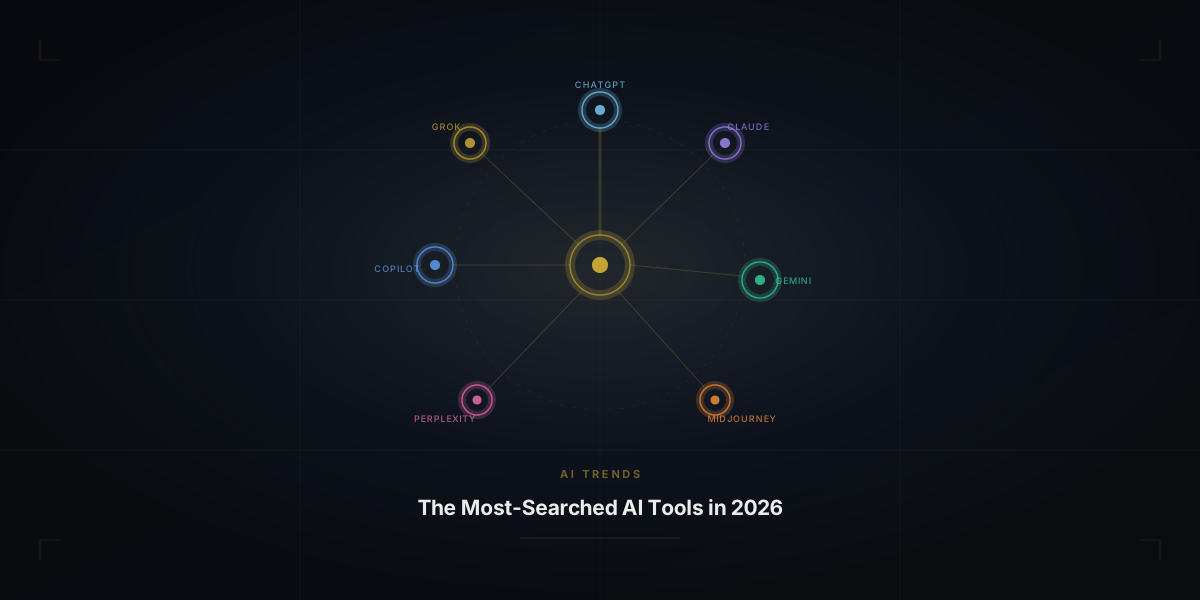
The Most-Searched AI Tools in 2026 — And What They Actually Mean For Builders
If you paid close attention to what people typed into search engines throughout 2025 and into 2026, a remarkably clear picture emerged. The top AI-related search terms weren't complicated or technical. They were the names of tools that did something immediately useful — and the questions people had about how to use them.
Understanding which tools are winning the search volume battle isn't just interesting trivia. It's a map of what users actually value, what experiences they're seeking, and where the real opportunity lies for businesses that want to build something people use every day.
Here's a breakdown of the most-searched AI tools and categories — and what each one tells you about the market.
The Top Searched AI Tools Right Now
1. Character AI — The Emotional Engagement Standard
Character AI has consistently ranked at or near the top of AI-related search volume, often outpacing even ChatGPT in certain demographics. That surprises a lot of people who assume the most searched AI would be the most "useful" one. Character AI's dominance reveals something important: people aren't just looking for productivity — they're looking for connection.
Character AI lets users create and converse with fictional characters, celebrities, historical figures, or custom personas. It's wildly popular with teenagers, writers, language learners, and anyone who wants interaction without judgment. The engagement metrics are staggering — users spend more time in Character AI than in most productivity apps.
The lesson for app builders: if your product creates a sense of personality, presence, or genuine interaction, it will retain users far better than one that feels like a tool. The best AI experiences feel like a relationship, not a transaction.
2. ChatGPT — The Benchmark Everyone Is Measured Against
ChatGPT remains the category-defining product that every other AI tool is compared to. Searches for ChatGPT include not just direct product searches but also "ChatGPT alternatives," "what ChatGPT can't do," "ChatGPT vs Gemini," and "how to use ChatGPT for [specific task]." This means it's not just pulling users — it's creating the vocabulary and expectations for the entire category.
For businesses: if your product has an AI component, users will instinctively compare it to ChatGPT. That's not a threat — it's an anchor. Positioning your AI feature as "better than ChatGPT for this specific task" is more effective than trying to compete on generality. Specificity beats breadth every time.
3. Google Gemini — The Enterprise Integration Play
Gemini searches have grown sharply as Google has integrated it across Workspace (Docs, Sheets, Gmail, Meet). Users are searching not just for "Gemini" but for specific use cases: "Gemini in Google Docs," "how to use Gemini to summarize emails," "Gemini vs ChatGPT for work." The enterprise integration angle is driving serious search volume from business users who were already living in Google's ecosystem.
What this signals: the next wave of AI adoption isn't about standalone tools — it's about AI woven into the software people already use every day. For software builders, this means the best AI features aren't add-ons. They're embedded directly in the workflows users are already running.
4. Claude — The Trust and Nuance Play
Anthropic's Claude has built a reputation for longer context, more nuanced reasoning, and fewer refusals compared to early ChatGPT versions. Searches for Claude often include "Claude for long documents," "Claude vs ChatGPT accuracy," and "Claude for research." The profile of a Claude user tends toward someone doing serious analytical work — legal professionals, researchers, consultants, senior executives.
Claude's rise tells you that trust and depth matter as much as speed and breadth. As AI becomes normalized, users will increasingly choose based on which tool they trust for their specific type of work. Building a product with a clear trust positioning — "most reliable for X" rather than "best at everything" — is a durable competitive strategy.
5. Perplexity AI — The Search Replacement
Perplexity AI searches are growing faster than almost any other AI product. Users describe it as "Google but it actually answers the question." It combines web search with AI synthesis and cites its sources — a combination that's proving extraordinarily powerful for research-heavy users. Searches for Perplexity frequently include "Perplexity vs Google" and "Perplexity vs ChatGPT" as users evaluate whether to switch their primary search behavior.
For businesses: Perplexity is becoming a major discovery channel. Being cited in Perplexity answers for relevant queries drives high-quality, high-intent traffic. The way to earn those citations is the same as with AI Overviews — clear, specific, useful public content that directly answers real questions in your space.
6. Microsoft Copilot — The Enterprise Incumbent
Microsoft Copilot search volume is driven heavily by enterprise workers who encounter it in their existing Microsoft tools and want to understand how to use it. Searches include "what can Copilot do in Teams," "Copilot for Excel," and "Microsoft Copilot vs ChatGPT." The fact that Copilot is embedded in tools that hundreds of millions of people use daily means its ceiling is enormous — even with lower engagement per session than standalone AI products.
For enterprise software builders specifically: if your product integrates with or extends Microsoft 365, Copilot compatibility is increasingly a procurement requirement. Buyers ask whether their new software works with Copilot the way they used to ask whether it worked with Outlook.
7. Midjourney and AI Art Generators — The Creator Economy Signal
Searches for Midjourney, "AI art generator," "AI image generator," and related terms represent an enormous category that often goes underappreciated in business-focused AI discussions. The scale of this search volume reflects something profound: people want to create, not just consume. They want tools that make them capable of things they couldn't do before.
This has direct implications for non-creative business software. Any product that makes a user feel more capable — more like an expert, more in control, more creative — retains better than one that merely automates. The design goal isn't efficiency alone. It's empowerment.
8. AI Detector — The Trust Crisis in Real Time
"AI detector" searches are a window into a growing anxiety: people can't tell what's real anymore. Is this email written by a human or a bot? Is this job application genuine? Did a student write this essay themselves? The demand for AI detection tools is a direct response to the proliferation of AI-generated content everywhere.
For businesses building on AI: this is a signal, not a threat. The businesses that win in a world full of AI-generated noise are the ones that lead with human judgment, genuine expertise, and authentic voice. Using AI as a tool to go faster is not the same as becoming indistinguishable from the AI itself. The difference matters to your customers, and it matters to how you're perceived in a crowded market.
What These Search Trends Reveal About User Psychology
Strip away the individual tool names and a consistent picture emerges about what people want from AI:
Immediacy. Every top-searched tool delivers value in seconds, not minutes. If your app requires a learning curve before delivering a result, you will lose users before they ever experience the value.
Specificity. Users search for AI that can do a specific thing — analyze their image, write their email, answer their research question. General AI is a starting point, not a destination. Products that specialize win loyalty.
Personality. The tools with the highest engagement (Character AI, ChatGPT, Claude) have distinct personalities. They feel like they have a point of view. Bland utility gets abandoned the moment something more engaging comes along.
Trust. The AI detector trend, the growth of Perplexity with citations, the preference for Claude's more measured tone — all of these point to users who are increasingly calibrating not just whether AI gives them an answer, but whether they can rely on it.
What To Build With These Signals
If you're thinking about incorporating AI into a product — or building an AI-native one — these search trends give you a strategic roadmap:
Build for a specific user in a specific situation. Don't build "AI for businesses." Build "AI that helps dispatch managers at trucking companies cut their scheduling time in half." The specificity makes you findable, referable, and hard to replace.
Give your AI a voice. The products with the highest retention have a character. Ariella is a deliberate example of this — not just a chatbot, but a specific personality with opinions, expertise, and a way of engaging that feels human. If your AI assistant feels like a toaster, it'll get treated like one.
Embed AI in the workflow, don't bolt it on. The Gemini and Copilot growth shows that AI embedded in existing tools wins over AI that requires context-switching. If you're adding AI to an existing product, put it where the work already happens.
Lead with trust signals. Given the AI detector anxiety, being transparent about how your AI works, what it does and doesn't do, and where human judgment remains in the loop is a competitive advantage, not just an ethical obligation.
The search data is telling you exactly what users want. The opportunity is in building the product that delivers it — specifically, reliably, and with enough personality to keep people coming back.